Showing posts with label book binding. Show all posts

Monday, April 14, 2014

Sketchbook Pages, Week One

 I've drawn in one of my sketchbooks every day this week and I intend to keep it up. It's a bit embarassing to post my wonky drawings but this blog is, in my mind, a way to record my work and progress so it serves my own purpose.

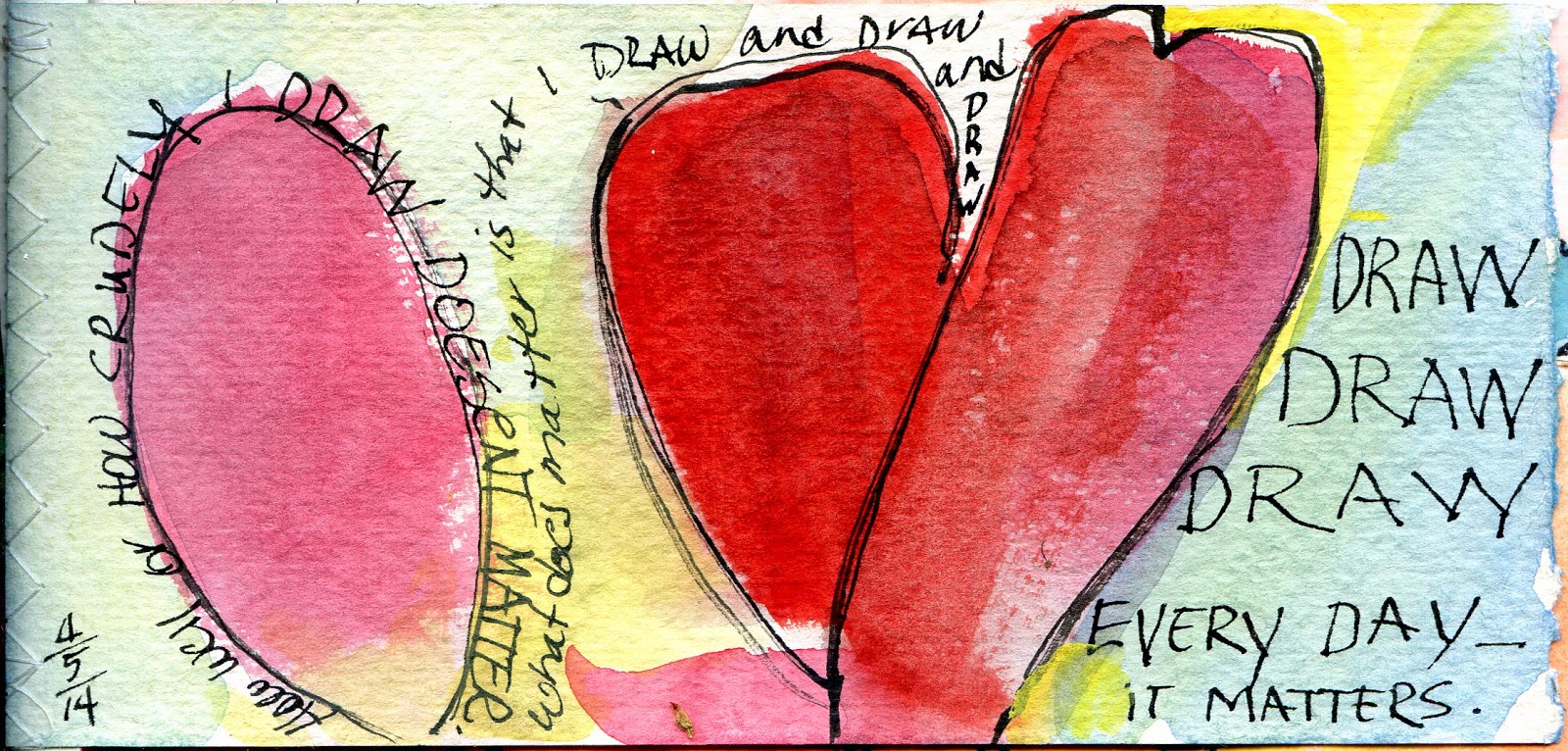
I'm working in an 8" square sketchbook I made. The pages are an assortment of watercolor papers, all shapes, sewn together to make nearly full sized pages. I save all my paper scraps as well as paper samples (waste not, want not) and this seemed to be a good use for them. Some papers work better than other. This first page is 7.5" x 3.5" and is sort of the introduction page.


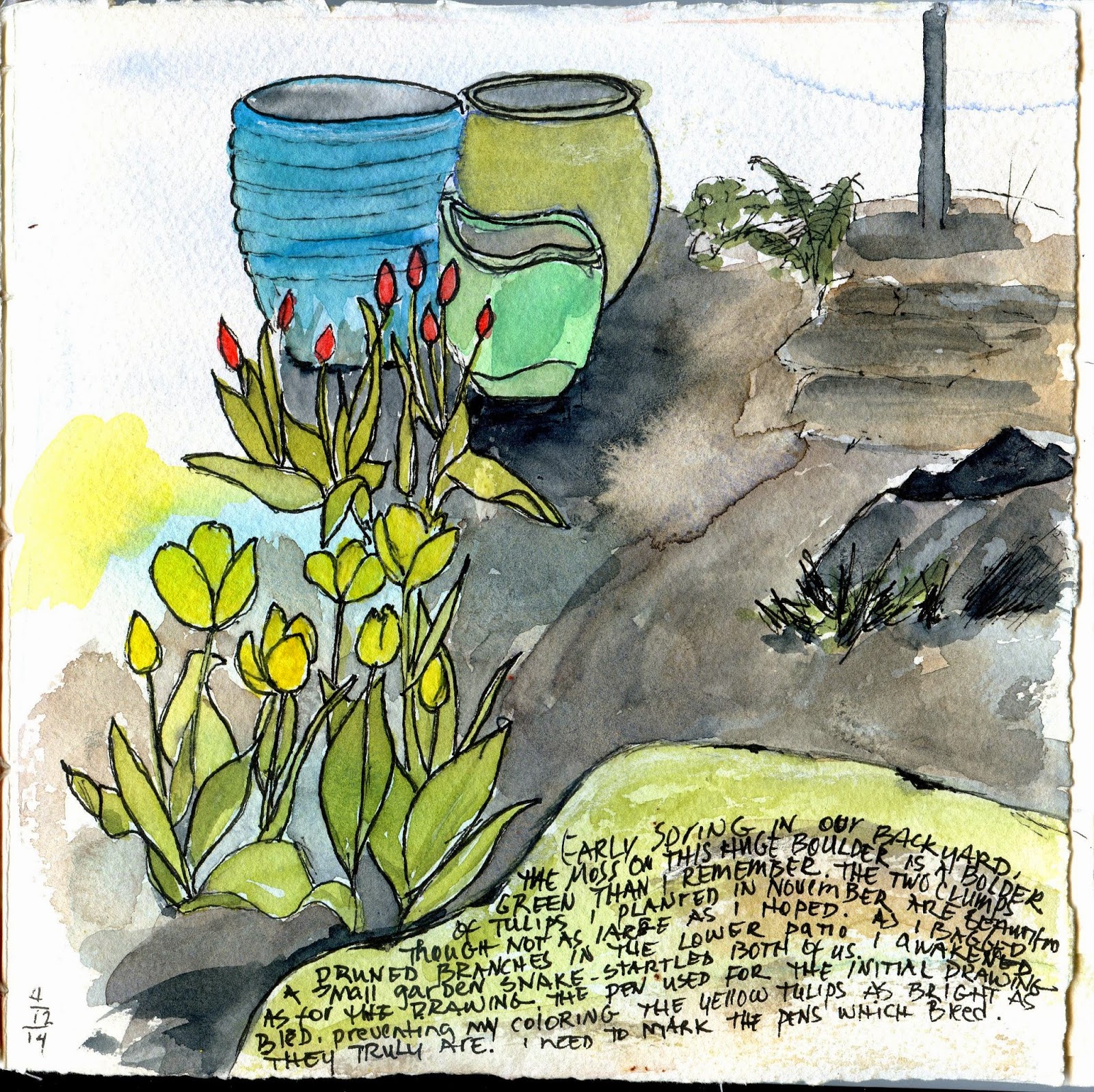
I did this page yesterday and am NOT happy with it. The pots are okay (I'm working on ellipses which are hard for me) but the pen I used wasn't waterproof so the minute I started adding watercolor the black ink made the page gray preventing me from painting bright colored tulips.


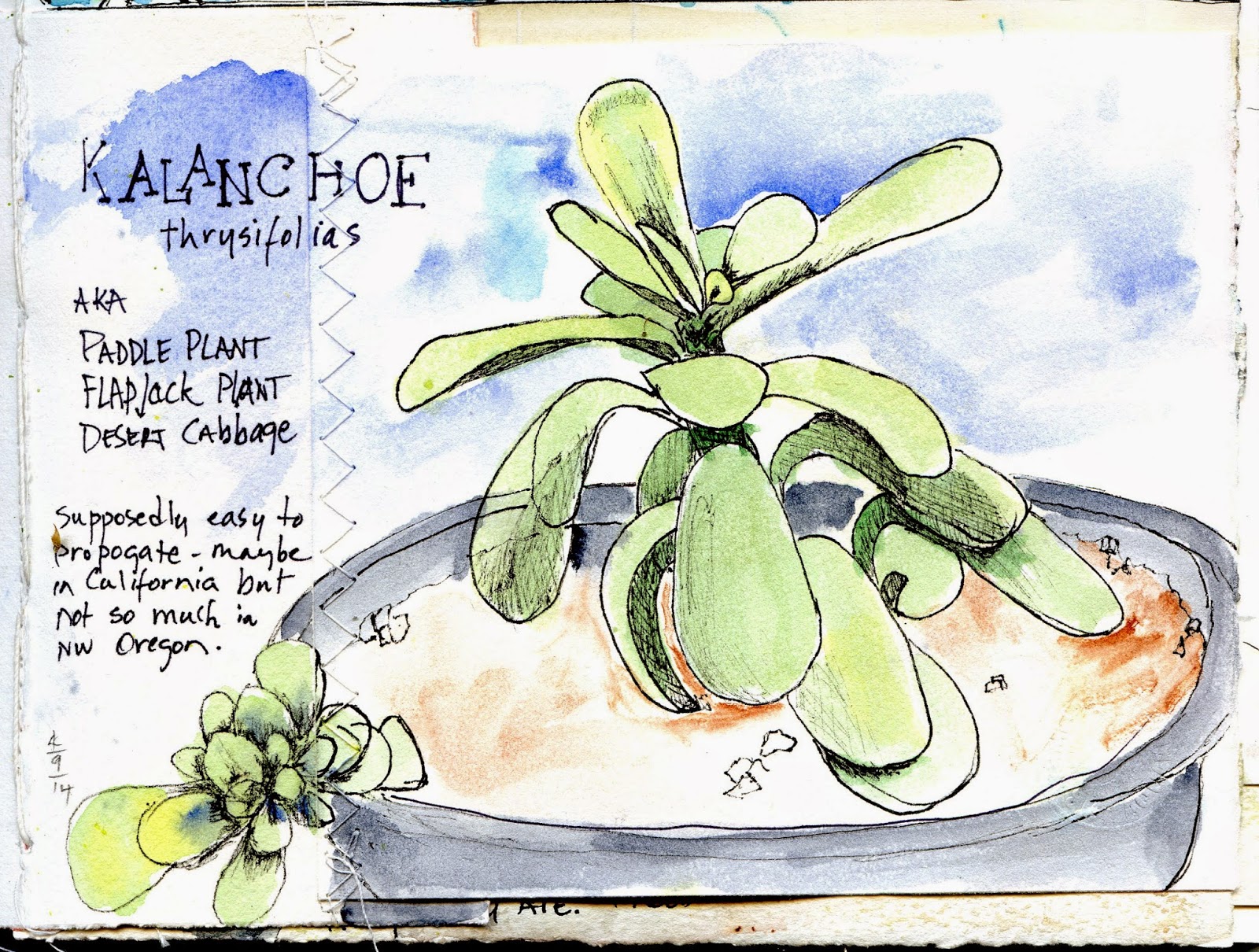
Perhaps you can get a better idea about the sewn together, pieced, pages in this example where the larger but shorter section on the right was zigzag stitched to the narrow piece on the left. I rather like the look.

Sunday, May 15, 2011

Repurposing Children's Board Books

Children's board books, the kind with super heavy pages, make great substrates for small paintings.
PREPARE THE BOARDS:
  1. Tear the book apart, page by page. Leave the tatters on the edges.
  2. Tear strips of cotton fabric, any weight from gauze to heavy duck, whatever you have. The strips should be approximately the size and shape of the boards. It's okay that the edges won't line up. This fabric helps cover the original images and colors and is used to add texture. Skip this step if you want smooth pages.
  3. Use any white glue (Elmer's, Sobo, PVA, etc.) to glue a strip of fabric to each side of each of the pages. Allow to dry.
  4. Optional: Coat all surfaces with acrylic gel medium to seal in any acids.
  5. Apply gesso liberally to all surfaces of the fabric and board. Dry.
USE THE BOARDS
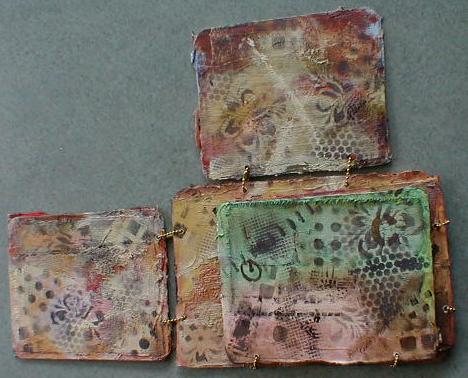
  1. For the above book I painted, stamped and stenciled my designs onto 5 prepared book pages, allowing paint to dry between coats.  I set 2 grommets in each page on the inner edges where one page would attach to another, and then used short chains to bind the pages together.
  2. I have used some of the single pages for the substrate for small paintings. Sorry, no pictures available.
  3. Some board books have large holes which can be useful to create a niche by gluing a page with a hole on top of a solid page and then put something into this niche.
  4. Of course one could tell a new story on the painted pages.


Wednesday, June 23, 2010

Making Journals from Scratch, continued

Studio Journals

“When you bind an art journal do you paint your pages before you bind the book or after it’s bound?”


Pages can be prepared either way. If you like the experience of opening a fresh journal with pristine white pages then go ahead and bind the paper into a book format using whatever binding structure you want… or skip the binding step and buy a blank book. My first art journals were blank coil bound books  but once I learned that I could choose my own paper and bind it myself that’s what I’ve done, (pictured above). I especially like gutting an old book that’s no longer useful and adding my own signatures using a good paper. There are lots of books, YouTube videos, and online tutorials/ classes that will walk you through the process.

My first self-bound art books were made following Teesha’s instructions here.

Other times, especially when I’m making a theme journal I’ll paint a few pages of a good paper and then tear it down and bind it as a coverless book. One such book is Teesha Moore’s 16 page journal.
 
I have a large stash of paper that has watercolor or acrylic paint on one side that I worked on in a class or as experiments that didn't come to completion, work that isn't frame-able the way it is. This paper is perfectly good and I keep it because I can't bear to throw away expensive paper, knowing that I can re-purpose it. That's what I often use for my journals and that’s what I used for my Nature Journal. Sometimes I do nothing further to the paper before tearing it down and other times I paint the other side in similar colors so there'll be continuity of color throughout the book.

For the Nature Journal I wanted to push back the color that was already on both sides of the paper so I tore it down to page-spread size and smooshed white gesso over the paint using a broad palette knife and a credit card as a squeegee. Gesso gives strength to the pages, keeps them flexible, and provides a good painting surface for acrylic paint or as a base for collage when using acrylic medium for the adhesive as I most often do.

Friday, June 18, 2010

Making Journals from Scratch

Black Journal Front
8 x 11

I spent a good part of yesterday binding a couple of new art journals and working in another. Both new journals are made of 140# watercolor paper, torn to size and assembled. For my black journal I first painted the paper on both sides with black gesso, just globbed on, and then tore it down to size. I sewed the 4 signatures, 20 pages, following Martha's directions on How to Rebind a Moleskine   Once I got the signatures stitched I realized that I'd rather have a soft book than one with stiff covers so I found an old acrylic painting on canvas and cut out a 4 x 11" piece to use as a spine and glued it to the front and back. So simple and easy and it looks nice, too.

Black Journal Back

Black Journal Spread
I used part of a watery acrylic painting for a page and sewed it to another piece of paper to make a 2 page spread. This is just the beginning.

For the other book I tore down two sheets of watercolors pours, stablized the folds with strips of fabric and lace, and smeared gesso over everything. The upholstery cloth spine was first sewn to a piece of canvas and  then I sewed each of the 5 signatures to the soft fabric spine with a simple Japanese stab binding.  (There's no decent photo of this one). I finished by gluing the canvas covers to the front and back pages of the signatures using Mod Podge. I know that I'll eventually want to paint the canvas covers but right now I don't know what I want so the painting will just have to wait. I'll show you when it's done.

2 page spread in canvas journal

Some days I much prefer making journals over working in them, but I'm hoping that these books keep me busy for the summer. I'm anxious to get out my acrylic paints and do lots of painting and collage in them.

Saturday, March 06, 2010

COOK BOOK - FOOD BOOK – GOOD FOOD

Something this much fun should be celebrated.

Crafts have a bad rap. I had forgotten how much fun I have using my technical skills in the studio. I’ve been busy as can be making another Remains of the Day art journal, this one about FOOD. As a former home economics teacher and a lifelong rather good cook (so my husband proclaims and he’s sticking to his story as long as it produces a few good meals every week) I have a love affair with good food, whether it comes from my kitchen, one of my friends’, or a favorite restaurant. It’s natural that I spend some time writing about the food in my life.

Once I decided to make a book about food I started collecting all sorts of related ephemera: labels from cans and bottles, recipes, photos, fabric, grocery bags and receipts, advertisements, and restaurant menus. I built my basic pages from menus and grocery bags and added all sorts of ephemera with my sewing machine. I typed a page of cooking terms and printed it on vellum which I then cut into strips and folded them in half to use to finish the edges of some of the pages.

Believe me, it’s addictive to make pages for these books but there’s a limit to the size of such a book since I’ll be adding writing and recipe cards and photos and it’s already quite fat at 22 pages divided between three signatures.

The cover is made from a Trader Joe’s paper bag. Both the cover and the inside of the cover were cut from one bag and a sturdy piece of light card stabilizes the inside. I did lots of machine sewing all over the cover and added handles from the same bag. That’s recycling, for sure. So far this book doesn’t have a tie but when it’s finished I may have to add something to keep it closed.

I work on my books at a rather small table which quickly becomes way too messy so I went hunting in the store room for something to corral the mess. I found a large tray that was once used in the darkroom, 2 small plastic boxes, a plastic shoe box, and a long drawer divider. The 2 small boxes (for small bits and labels) fit perfectly in the shoe box, leaving room at the back for larger paper to stand. And the space in front is large enough for magazines and full sheets of paper. Alongside the big tray is the long tray for strips of paper. And at my feet is my big cookie jar of ribbons and a tote full of fabric scraps.

Stay tuned. I intend to make a video of this book before long.

Thursday, August 13, 2009

Coil Binding for Journals


Gina asked about how I bind my journals. Several years ago I was teaching some workshops on travel journals and I splurged and bought myself a holepunch for coil binding, (like the plastic coil used in spiral notebooks). This isn’t your everyday holepunch; it punches a jillion holes at once, perfectly spaced, through several sheets of paper. It wasn’t an economical move but I’ve loved being equipped to create my own unique spiral/coil bound journals with my paper of choice. I like the coil binding for my sketchbooks because I can turn the pages back on themselves and have a solid platform for writing or making art. I bought my coil punch from Bonnie’s Best.
Most copy stores will be able to coil bind your books for a small fee, usually around $5. Assemble your pages, clamp them firmly with some bulldog clips on every edge except where the spiral coil goes… and on that edge put a big yellow Post-it with an arrow pointing to the edge you want punched… PUNCH HERE. They may take off the bulldog clips but hopefully the note will stay in place and they’ll do it right.
Sometimes when I have a hardback book that I’ll be using a lot in the studio I’ll take the book to the copy store and have them slice off the spine along with about ¼” of the spine edge of the book, and have holes punched in the book so it will fit into a 3 ring binder or punch it for a big fat coil if they have the large size in stock.

Friday, August 07, 2009

Hawaii Travel Art Journal 2009


I've been working on the journal that I'll take to Hawaii in a couple of weeks. I decided to go with a 6X6" format and started by cutting lots of paper to size. I used some of my stencil paper from class as well as commercial scrapbook paper with designs on both sides, and I added plenty of 90# watercolor paper. Then I sewed narrow pieces together to get a full size page, adding embellishments. I left space for journaling both on plain paper and on top of decorated paper. I'll work on the journal on the plane as well as once we arrive.


Tomorrow my daughter and her 3 oldest will come over to construct their own journals. I have lots of cut-t0-size paper as well as lots of pretty paper to add to their pages. The oldest will be in charge of the sewing machine; the oldest daughter knows how to use my paper cutter; the youngest will be comic relief and creative director; my daughter will supervise, and I'll punch the holes for binding.

Sunday, December 21, 2008

Sketchbook Journaling


For years I've kept an art journal of one kind or another and I've often made the books by gutting a discarded book and rebinding it with my preferred papers. But right now I prefer coil bindings over sewn bindings because I can fold the pages back on themselves for more comfortable working.
My journals aren't sketchbooks although they contain many sketches. They aren't diaries although they contain many personal observations. They could more accurately be called repositories because this is where I keep notes, lists, art ideas, workshop notes, sketches, web addresses, gallery show announcements, images from magazines, and pictures of my grand kids, among other things. They're quite colorful and once I get a few pages done in a book it compels me to keep going. Sometimes when I'm painting I'll swipe some color across a blank page so the page isn't so difficult to mess up with something else... it's my way of getting around the fear of the blank page.
I'm not alone in this love affair with the blank book. I'm currently devouring Danny Gregory's newest book about journaling, An Illustrated Life. Danny features the sketchbooks of 50 artists, illustrators and designers, giving them each 4 to 6 pages to showcase some of the pages from their own journals and giving each of them a voice to tell the reader when, where, why and how they journal. If you keep a sketchbook or journal I recommend that you buy this book and read every word. The book has "meat", heft, real content and if you aren't inspired to spend more time drawing I'll be very surprised. Danny's original book, Everyday Matters, emphasizes that anyone can draw. I believe that. It just takes practice, every day practice, because you see, drawing everyday does matter.
Jo
Related Posts Plugin for WordPress, Blogger...